
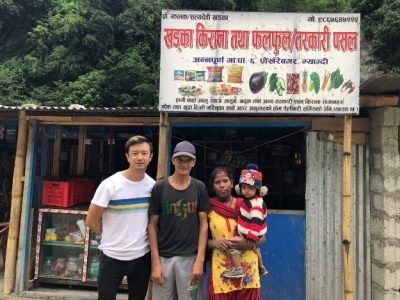
SatyaDevi and Jhalak Khadka, a pair of rural model farmers, are still breaking the belief that only women do household work in the society and that the earning and business aspects should be done only by male members. The couple living in Pokharebagar of Annapurna Rural Municipality-6 in Myagdi are an example from the point of view of gender equality and social integration.
Satyadevi’s family relied on traditional farming so that they had no other source of income. At a time when there was no basic need to sustain life, the number of families was increasing, so worried Satyadevi decided to send money to the neighbors by collecting money and saving the money she had saved.
The family fell into debt after Satyadevi asked her husband to return home after the company did not pay him even after working for seven months in the Gulf. On the one hand, the debt on the debt and on the other hand, after the tension of ke khao ke lau of tarpam, satyadevi’s jewelry was sold and lost again.Unfortunately, within three months, the company sent him home after the medical report deteriorated. The family was tired due to poverty and Jhalak had added more debt to the debt, there was no other option, so he went abroad again. This time, he reduced the loan, but it did not happen and returned to Nepal. After Jhalak returned to Nepal, he had to earn a living, so he started working as a wage labourer.Satyadevi became pregnant for the second time and as the delivery time was nearing, she did not have to go to the hospital at home and other necessary expenses. The society did not allow her to stay in the birthplace saying that it would be inauspicious not to give birth in the birth place and she came to the cowshed and gave birth. For the last six days of delivery, she has been doing all the household chores on her own, instead of asking her husband for help, she turned her face to do the work of the woman herself.
When Satyadevi underwent a five-day training as a rural model farmer, her daughter was 15 months old. The training taught us how to grow a variety of vegetables and fruits in our own fields and feed our children as well. She started farming by renting land. Apart from this, she started selling eggs and milk in the local market by rearing chickens and cows and buffaloes. “Regular follow-up and consultation of Suahara Field Supervisor and Suahara Program Technical Officer of Milan Myagdi has led to an increase in the marketing of her products and the opportunity to understand the importance of nutrition and health in a span of 1000 days. He has formed a household food production group called Chahana Krishak Group and gathers 1,000-day-old women to discuss the importance of household food production, the importance of sanitation and nutrition, increasing and marketing production.After getting the local market for some products, they have started a small shop by renting land in the nearby market with the aim of increasing the business. Satyadevi got the opportunity to take business plans, loans and savings training from suahara program and after knowing about the benefits, losses and market value from the training, she cultivated seasonal vegetables on 3 ropanis with the determination to increase her business by selling buffaloes and goats reared at home. A group of rural model farmers is being registered in the municipality. Around 1,000-day-old mothers’ families and rural model farmers from nearby villages collect and sell vegetables produced by them. He says he earns Rs. 60,000. A 1,000-day-old couple from Annapurna rural municipality was given a three-day training on gender equality and social inclusion. Since then, her husband’s behavior has changed.Jhalak said that after the training, he helps in household work and works on household advice and motivates other neighbors to share household work and not burden women only. Jhalak says that after playing stone games in training, the burden of work has finally been felt and the women do not see the household work done at home and see only two paise earned by going out and earning money have been removed and the burden of work is more even if the women stay at home. Therefore, suahara has expressed his gratitude to the program for organizing the training. Satyadevi says, “I am indebted to Milan and Suahara programs. I didn’t think my husband would change so much. He prepares to send his child to school, helps with homework and collects vegetables and fruits from nearby villages. You have also seen the work of the house, there is no fencing, so soon the change has happened, it is expected that this change will be sustainable.
Presenter: Sakshi Poudel
Household Food and MarketingOfficer
SuaharaProgram
June 8, 2017.